Download PDF
By beginning to read this book as soon as possible, you could quickly locate the right way to make far better top qualities. Utilize your leisure time to read this book; even by pages you can take a lot more lessons and motivations. It will not restrict you in some occasions. It will free you to constantly be with this publication each time you will read it. is currently readily available below and also be the first to obtain it now.

Download PDF
Don't you believe that you require brand-new means to lead your room time much better? Keep ahead with great behavior. Reviewing is among the most effective referrals for you. Yet, selecting the very best analysis publication is also important. It will certainly affect how you will certainly obtain the advances. It will reveal you the high quality of guide that you read. If you require the sort of book with excellent quality, you can pick Why should be this book? Come on follow us to recognize why as well as the best ways to get it.
But below, we will reveal you incredible thing to be able always check out the publication any place and also whenever you happen and also time. Guide by only can help you to recognize having the book to check out each time. It will not obligate you to constantly bring the thick publication anywhere you go. You can merely keep them on the gizmo or on soft file in your computer system to consistently check out the room during that time.
Asking why? You have actually seen that this site contains terrific publications from alternative releases a collections on the planet. Getting a minimal version book is additionally simple here. You could discover , as example to be your turn and also your choice currently. Due to the fact that, we will certainly not hide anything concerning it here. We offer you all the very best from that the writer produced specifically for you.
It is not only to provide you the easy means yet additionally to get the book is soft data systems. This is the reason why you can obtain the book immediately. By linking to web, your possibility to locate and obtain the asap. By clicking web link that is proffered in this site, you can go to directly guide site. As well as, that's your time to get your preferred publication.
Product details
File Size: 7804 KB
Print Length: 262 pages
Page Numbers Source ISBN: 1629581704
Simultaneous Device Usage: Up to 4 simultaneous devices, per publisher limits
Publisher: Routledge; 1 edition (July 1, 2016)
Publication Date: July 1, 2016
Sold by: Amazon Digital Services LLC
Language: English
ASIN: B01HTW1FSW
Text-to-Speech:
Enabled
P.when("jQuery", "a-popover", "ready").execute(function ($, popover) {
var $ttsPopover = $('#ttsPop');
popover.create($ttsPopover, {
"closeButton": "false",
"position": "triggerBottom",
"width": "256",
"popoverLabel": "Text-to-Speech Popover",
"closeButtonLabel": "Text-to-Speech Close Popover",
"content": '
});
});
X-Ray:
Not Enabled
P.when("jQuery", "a-popover", "ready").execute(function ($, popover) {
var $xrayPopover = $('#xrayPop_4282D5D852B311E99AA99807A9BC19DD');
popover.create($xrayPopover, {
"closeButton": "false",
"position": "triggerBottom",
"width": "256",
"popoverLabel": "X-Ray Popover ",
"closeButtonLabel": "X-Ray Close Popover",
"content": '
});
});
Word Wise: Enabled
Lending: Not Enabled
Screen Reader:
Supported
P.when("jQuery", "a-popover", "ready").execute(function ($, popover) {
var $screenReaderPopover = $('#screenReaderPopover');
popover.create($screenReaderPopover, {
"position": "triggerBottom",
"width": "500",
"content": '
"popoverLabel": "The text of this e-book can be read by popular screen readers. Descriptive text for images (known as “ALT textâ€) can be read using the Kindle for PC app if the publisher has included it. If this e-book contains other types of non-text content (for example, some charts and math equations), that content will not currently be read by screen readers.",
"closeButtonLabel": "Screen Reader Close Popover"
});
});
Enhanced Typesetting:
Enabled
P.when("jQuery", "a-popover", "ready").execute(function ($, popover) {
var $typesettingPopover = $('#typesettingPopover');
popover.create($typesettingPopover, {
"position": "triggerBottom",
"width": "256",
"content": '
"popoverLabel": "Enhanced Typesetting Popover",
"closeButtonLabel": "Enhanced Typesetting Close Popover"
});
});
Amazon Best Sellers Rank:
#340,823 Paid in Kindle Store (See Top 100 Paid in Kindle Store)
Let me be clear (where have we heard that before?). I am neither an academic nor a museum professional and only came across this book by accident. However, as a layman I'm very much interested in museums in general, including historic houses and communities, of which my wife and I have visited many and worked for both as a professional (my wife, as a history museum exhibit and program director) and volunteer (myself, as an art museum docent).Let's also be clear that the Guide is not a comprehensive "how-to" on running historic houses. Most notably it does not deal with financial issues or with mission concepts, at least not directly. Rather, focus is on the "visitor experience" and how to draw audiences to historic houses. If I had to pick one phrase to describe what the authors think of most historic house operations today, it would be "too anal" (as borrowed from Freud).The heart of this small book is 132 pages of practical thinking and examples of how to make historic houses more attractive and welcoming to visitors, both by reaching out to the communities in which they live, and by providing memorable experiences to their clients (visitors). Those pages are book-ended by sections that formalize the authors' approach, yet overall the writing and ideas are readily accessible to those outside the academy, for whom the book has obviously been written. The authors point out that historic houses are seeing declining visitor numbers, and their purpose is to help these institutions reverse that trend. They also admit that while some of their ideas are research-based, others are mere conjecture, and they invite the museum community to contribute to their ongoing "anarchist" project.Although the "anarchist" tag is catchy, I'd say Ryan and Vagnone are radical rather than "anarchic." I hate to use this phrase because it's become a cliche, but what they are really asking house museum people to do is "think outside the box" (house). Ideas are divided into five categories: (1) reach out to, which means become involved with, the surrounding community; (2) focus on communications, understanding that communication with visitors is a two-way street (what your visitors tell you is just as important, if not more so, than what you tell them); (3) somewhat related to the number (2) as I see it, make the historic house a shared experience in which visitors are invited to participate in the house experience through their experiences; (4) take a holistic approach to the house and its objects/artifacts (and its history, implicitly); and (5) loosen up and take a practical, realistic approach to preservation and hard assets. I hope this is a fair summary.Clearly (again) not all that the authors suggest is going to translate perfectly to every historic house -- some might think, "Whoa, we can't do that," and in some cases they'd likely be right. But, think hard about all this "stuff," that's the message I get. Finally, I'd add that many of the authors' suggestions, such as encouraging your tour guides or docents to go NUDE, are translatable to other kinds of museums. Now, if that doesn't make you want to read the book, I'm not sure what will.
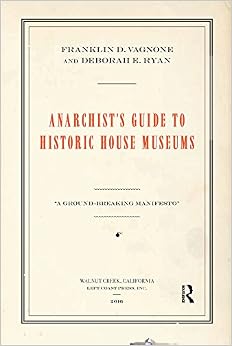
The Anarchist’s Guide to Historic House Museums offers fresh ideas for museum administrators and staff to evaluate and improve the visitor experience to their historic house museums (HHMs). The authors, Franklin D. Vagnone and Deborah E. Ryan, use a variety of HHM case studies to illustrate their points. Each chapter in the book opens with a thought-provoking quote by a museum representative that the authors explore throughout the chapter, offering insights and recommendations for making HHMs relevant to the community and meaningful to the visitor. The authors define a key problem on p. 59: “For many HHMs, it will initially be difficult to find ‘a place of relevance and meaning, to genuinely contribute to building better communities and serving the needs of individuals, and to define the new normal in a world that no longer derives knowledge from objects, looks to institutions for answers, or defines reality through materiality’.†The ideas and suggestions presented in the book apply not only to HHMs, but to many different types of organizations. While I was reading The Anarchist’s Guide, I visited a well-known HHM in Manhattan and experienced many of the elements it described that detract from the visitor experience. I came away thinking the director should really read this book. During the same week, I visited a small, state-funded museum with a limited collection, yet I got the impression that the museum administration had definitely read the book and successfully implemented many of its suggestions to increase visitor engagement. The difference between the two experiences proved to me that The Anarchist’s Guide to Historic House Museums is a useful tool for HHM administrators and staff to improve their institutions and remain relevant.
Great source for ideas about reframing cultural heritage institutions. Definitely focused on Historic House Museums, but a lot of what's being talked about could be applied to archives, special library collections, historic sites, non-history museums. It's a whole series of little case studies about why we need to stop being so darn precious about everything and aim for relevance to visitors.The way it's organized is a bit off-putting-- for someone who still habitually "guts" books like I learned to in grad school, this book was a little challenging at first. But after reading it through, you get to the point about a third of the way in where you can jump around a bit. Would definitely recommend.
I'm a Museum Studies student and I really enjoyed seeing all the case studies in this book. While it is focused on historic houses, I believe that many of the suggestions are applicable to all museums.
This should be required reading for all docents at all HHms everywhere. I am so thrilled and excited to begin implementing the suggestions in the two Historic Homes I am involved with!!!
Very helpful book by an experienced expert on house museums. Our Group is working on a house museum relating toDr. James Still; his life and times in Medford, NJ. in the 1800's. Nice to know we are not alone and that many others out there have the sameconcerns and challenges.
Great book with a fresh approach to museums.
Liked the anarchist approach to keeping historic house musuems current. Can pick and choose what might work at your institution. Change is hard!
PDF
EPub
Doc
iBooks
rtf
Mobipocket
Kindle


Posting Komentar